
What is Tu Bishvat and when do we celebrate it?
Tu Bishvat ('New Year' for trees)
Tu Bishvat literally means the 15th day of the Hebrew month of Shvat (sometimes spelt as 'Shevat' in English). Tu Bishvat is the Jewish New Year of the trees, falling at the time when most trees in Israel begin to bud. There is no mention of Tu Bishvat in the Bible, hence it is a minor holiday as it is a rabbinic enactment. Tu Bishvat falls during the secular months of January or February.
Tu Bishvat has relevance in Jewish law because as it marks the date of all annual tithes on fruit in Eretz Israel (the Land of Israel). Our observance of the holiday also expresses our close ties to the Holy Land.
The main customs and traditions of Tu Bishvat were developed in Israel in ancient times. The Jews took these customs and traditions with them when they went into exile, carrying them and with them, memories of their homeland, throughout their wanderings in other lands.
Historical Background
Rabbis during the time of the Mishnah discussed on what date the new year for trees should be considered to start. This had important religious significance as the Torah prohibits the use of trees for some purposes or their fruit if the trees are below a certain age. All trees are considered to be one year older than previously when the calendar reaches Tu Bishvat (this is similar to how Horses' Birthday works in Australia where all horses are considered to be one year older when it is the 1st of August). Various dates in the Jewish month of Shvat were put forward, but only in the 10th century did the Rabbis finally all agree to regard the 15th of Shvat (Tu Bishvat) as the new year for trees, the day on which all trees would be considered to be one year older than previously.
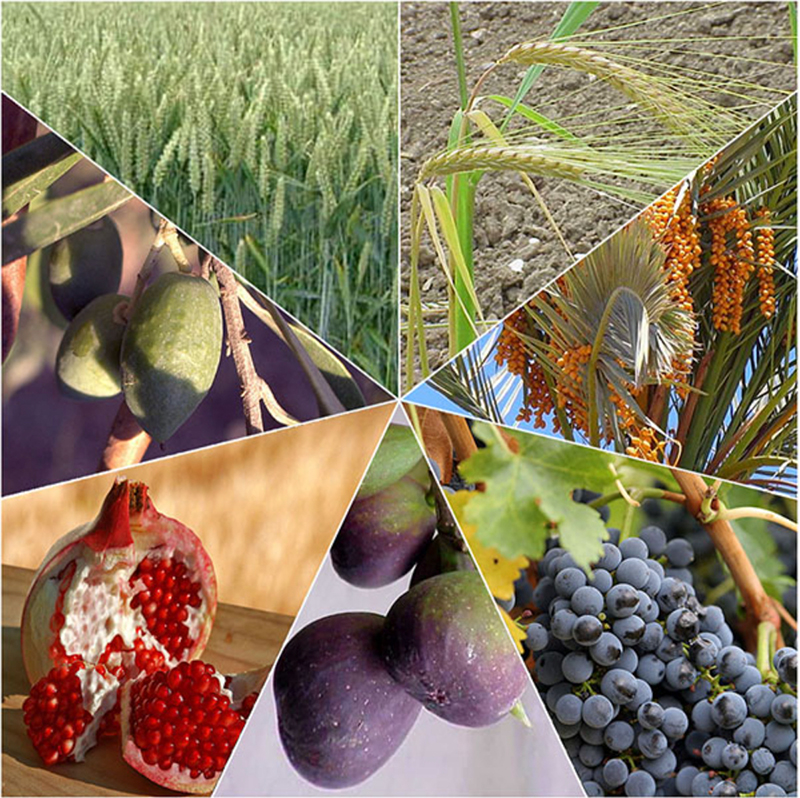
The 'Seven Species' of natural produce (listed in Deuteronomy 8:8) are particularly associated with the land of Israel.
On Tu Bishvat Jews would put fruits on their table for which the land of Israel was and is legendary, and which were brought to the Temple in Jerusalem: raisins (grapes), olives, figs, dates, pomegranates and the grains (wheat and barley) which make up the seven species of the land. Eating these sweet fruits helped to take away some of the bitterness of the Jews life in exile and served as a reminder that Israel was waiting for their return.
As it is written in Devarim (Deuteronomy) 8: 7-8, "For the Lord God will lead you into the good land, a land flowing with waters... A land of wheat and barley and vine, of fig and pomegranate, the land of the olive and [date] honey".
Today, Tu Bishvat is not only a day when fruits from Israel are eaten, but also a day when Jewish people plant trees, as it is written in Vayikra 19:23, "And when you shall enter this land (Israel), you shall plant fruit-bearing trees".
This idea is amplified in Vayikra Rabba 25: "The Holy One, blessed be He, occupied Himself with planting immediately after Creation of the world. For it is specifically written: 'And the Lord God planted a garden in Eden'. So shall you also, when you enter the land of Israel, first of all occupy yourself in planting."
How do we celebrate Tu Bishvat?
Eating Fruits
A very important custom of Tu Bishvat is eating fruits for which Israel is known. As well as the seven species (mentioned above) we eat other fruits associated with srael, in particular almonds, citrus fruits, and apples. According to the Jewish mystical tradition (Kabbalah), eating fruit is a pathway to spiritual improvement.
Planting Trees
Tu Bishvat relates to the cycles of the seasons in Israel and is also known as "the birthday of the trees". In Israel at this time children take shovels and hoes, and go singing happily to plant trees. They have parties when they have finished, where they sing more songs, eat fruit and dance around the trees.
In the Diaspora (countries outside of Israel) Jewish people plant seeds or trees where they live, or send money to Israel for people there to plant trees for us.
Supporting the Jewish National Fund (JNF)
The Jewish National Fund (JNF) is called Keren Kayemet LeYisrael in Hebrew. It is the largest foundation within the Zionist movement and its primary aim since 1901 has been to acquire land in Israel for settlement and reafforestation. Jewish people have fostered tree planting and environmental programs in Israel as an expression of their commitment to the land since the JNF was founded.
On Tu Bishvat in 1949 a memorial was held for those who had fallen in the War of Independence. Then Prime Minister, David Ben-Gurion, planted the first tree. The Knesset (Israeli parliament) celebrates its own birthday on Tu Bishvat as the date marking its first session.
The Tu Bishvat Seder
Origins of the Tu Bishvat Seder
During the 16th century, Safed (Tsfat in Hebrew) became the centre of Kabbalah (Jewish mysticism). Kabbalists developed new meanings and rituals for celebrating and rejoicing in the birthday of the trees. Families would gather round tables that were set with a white cloth, flowers and fruits as well as red and white wines. This feast was modelled, to a degree, on the Pesach Seder.
The ceremony for Tu Bishvat includes readings from the Torah, Talmud and the Zohar (a key kabbalistic text). These readings include special blessings to be said over fruits and flowering and fruit-bearing trees. After these blessings are said, four cups of wine shading from white to red are drunk, and at least three kinds of fruit consumed.
As the Tu Bishvat seder is of kabbalistic origin, it tends to be observed predominantly by hassidic and other families with a particular interest in kabbalah.
Preparation for the Seder
The term 'seder' means 'order'. It indicates that there is a ritual sequence that occurs during the meal. The order of events is written down in a special book called a Haggadah (which means 'telling).
The Haggadah leads one through the Seder. One is able to make modifications to the structure, as it is fairly general and flexible. During the Seder for Tu Bishvat, we drink four cups of wine and eat different types of fruit to represent the seasons. The wine and the fruit are eaten in a symbolic manner, progressing in either character or colour.
There is no need to clean one's house for this Seder as the restrictions of Pesach do not apply, and there is no necessity to buy any special food products except for the fruits used at the Seder. The table is supposed to be festive in nature and the whole family should participate and have fun. The main foodstuffs necessary are:
- Red and white wines
- Fruits that have hard coverings
- Fruits that have soft coverings with seeds in the centre
- Fruits that are wholly edible
The Seder
The First cup of wine
White wine is used for the first cup as white is the colour of snow. This corresponds to the winter season when the land is barren and nature is resting.
The prayer for wine is recited:
"Ba-ruch ata A-do-nai El-o-hay-nu mel-ech ha-olam bo-ray pree ha-gafen."
"Blessed are you, Lord our God, Ruler of the Universe who has created the fruit of the vine."
We then start to eat some of our fruits. We first choose fruits that have a soft inside and a hard covering. Some examples include: nuts (with shells), pomegranates, and coconuts. We eat these fruits to remind ourselves that although the ground is hard from the winter, there is life underneath the ground that is waiting to be born again in the spring. Before eating the fruits, we say a blessing:
"Ba-ruch ata A-do-nai El-o-hay-nu mel-ech ha-olam bo-ray pree ha-etz."
"Blessed are you, Lord our God, Ruler of the Universe who has created the fruit of the tree."
The Second cup of wine
White and red are the colours of the second cup. It is actually a white wine that has some red mixed in with it. These colours depict the earth coming alive again with the start of spring. The winter snow is slowly melting away, and the ground from winter is changing into the colours of spring. Before we take a sip of the wine, we recite the blessing:
"Ba-ruch ata A-do-nai El-o-hay-nu mel-ech ha-olam bo-ray pree ha-gafen."
"Blessed are you, Lord our God, Ruler of the Universe who has created the fruit of the vine."
It is now time to eat some more fruits. The next type of fruit we eat has a hard inner core and a soft cover on the outside. Examples of these fruits include: olives, dates, peaches). These fruits are indicative of the changing season. From the cold winter, where we ate fruits with a hard covering, we now eat softer fruits to show that the land is changing; thawing out. We say a blessing over the fruits before we taste them:
"Ba-ruch ata A-do-nai El-o-hay-nu mel-ech ha-olam bo-ray pree ha-etz."
"Blessed are you, Lord our God, Ruler of the Universe who has created the fruit of the tree."
The Third cup of wine
Red and white are the colours of our third cup of wine. It is red wine that has some white wine mixed in with it. These colours serve as a reminder of the abundant fruits available during the summer time. The red wine is indicative of life; the richness and beauty of life during the summer. Before we drink our wine, we say the blessing:
"Ba-ruch ata A-do-nai El-o-hay-nu mel-ech ha-olam bo-ray pree ha-gafen."
"Blessed are you, Lord our God, Ruler of the Universe who has created the fruit of the vine."
Now it is time to eat some more fruit. This time, we eat fruits that are soft all round. These fruits are symbolic of an earth that is once again alive and flourishing. Examples of these fruits include raisins, grapes (seedless), or figs. Before we can eat our fruit, we say the blessing:
"Ba-ruch ata A-do-nai El-o-hay-nu mel-ech ha-olam bo-ray pree ha-etz."
"Blessed are you, Lord our God, Ruler of the Universe who has created the fruit of the tree."
The Fourth cup of wine
Red is the colour of the fourth cup of wine. The seasons are changing and autumn is coming in. The red is indicative of the leaves turning a reddish brown colour as they fall off the trees. The prayer for wine is recited before we drink:
"Ba-ruch ata A-do-nai El-o-hay-nu mel-ech ha-olam bo-ray pree ha-gafen."
"Blessed are you, Lord our God, Ruler of the Universe who has created the fruit of the vine."
It is now time to eat some more fruit. This time we enjoy the fruit- the essence of the entire fruit. We no longer worry about the appearance. We have already eaten fruits with a soft centre and hard covering, a hard centre and a soft covering and a wholly soft fruit. Before we eat, we say the blessing:
"Ba-ruch ata A-do-nai El-o-hay-nu mel-ech ha-olam bo-ray pree ha-etz."
"Blessed are you, Lord our God, Ruler of the Universe who has created the fruit of the tree."
Some people follow the Seder with a tree planting ceremony or a walk through a place of great natural beauty. In Australia, where Tu Bishvat usually falls in late summer, picnics and hikes through National parks are particularly popular.
Back to the Jewish Holidays page of Jewish World Life Online